AR400 steel heat treatment is a critical process in enhancing the mechanical properties of this high-strength, abrasion-resistant steel. Globally, the demand for durable materials in industries like construction, mining, and heavy equipment is constantly increasing, making efficient and reliable heat treatment methods for AR400 steel paramount. This process directly impacts the lifespan and performance of critical infrastructure and equipment worldwide.
The economic implications are significant. Properly heat-treated AR400 steel reduces the frequency of replacements and repairs, lowering lifecycle costs for businesses and governments. As infrastructure ages and the need for resource extraction grows, optimizing AR400 steel heat treatment becomes a key factor in sustainable industrial practices. Understanding the intricacies of this process is essential for professionals in material science, engineering, and manufacturing.
Furthermore, advancements in heat treatment technologies directly contribute to increased safety and reliability in applications where AR400 steel is utilized. This spans from ensuring the structural integrity of bridges and buildings to safeguarding workers in demanding mining environments. Effective ar400 steel heat treatment is not merely a metallurgical procedure; it's a cornerstone of modern industrial resilience.
Introduction to ar400 steel heat treatment
AR400 steel, renowned for its exceptional resistance to abrasion and impact, requires specific heat treatment protocols to unlock its full potential. The process involves carefully controlled heating and cooling cycles that modify the steel's microstructure, resulting in enhanced hardness, toughness, and weldability. This isn’t simply a ‘one-size-fits-all’ procedure; the optimal parameters depend heavily on the intended application and desired mechanical properties.
Understanding the nuances of ar400 steel heat treatment allows manufacturers and engineers to tailor the material's characteristics to meet the demanding requirements of diverse industries. From improving the wear resistance of excavator buckets to strengthening the structural components of heavy machinery, a well-executed heat treatment regime is fundamental to maximizing the service life and performance of AR400 steel products.
Defining AR400 Steel and Its Heat Treatment
AR400 steel is a high-strength, low-alloy steel frequently utilized in applications where abrasion resistance is paramount. The “AR” designation signifies “Abrasion Resistant,” and the “400” indicates a nominal hardness of 400 Brinell. It's a common grade within the broader family of AR steels, known for their balance of hardness, toughness, and weldability. This steel composition typically includes manganese, carbon, and other alloying elements designed to enhance its wear-resistant properties.
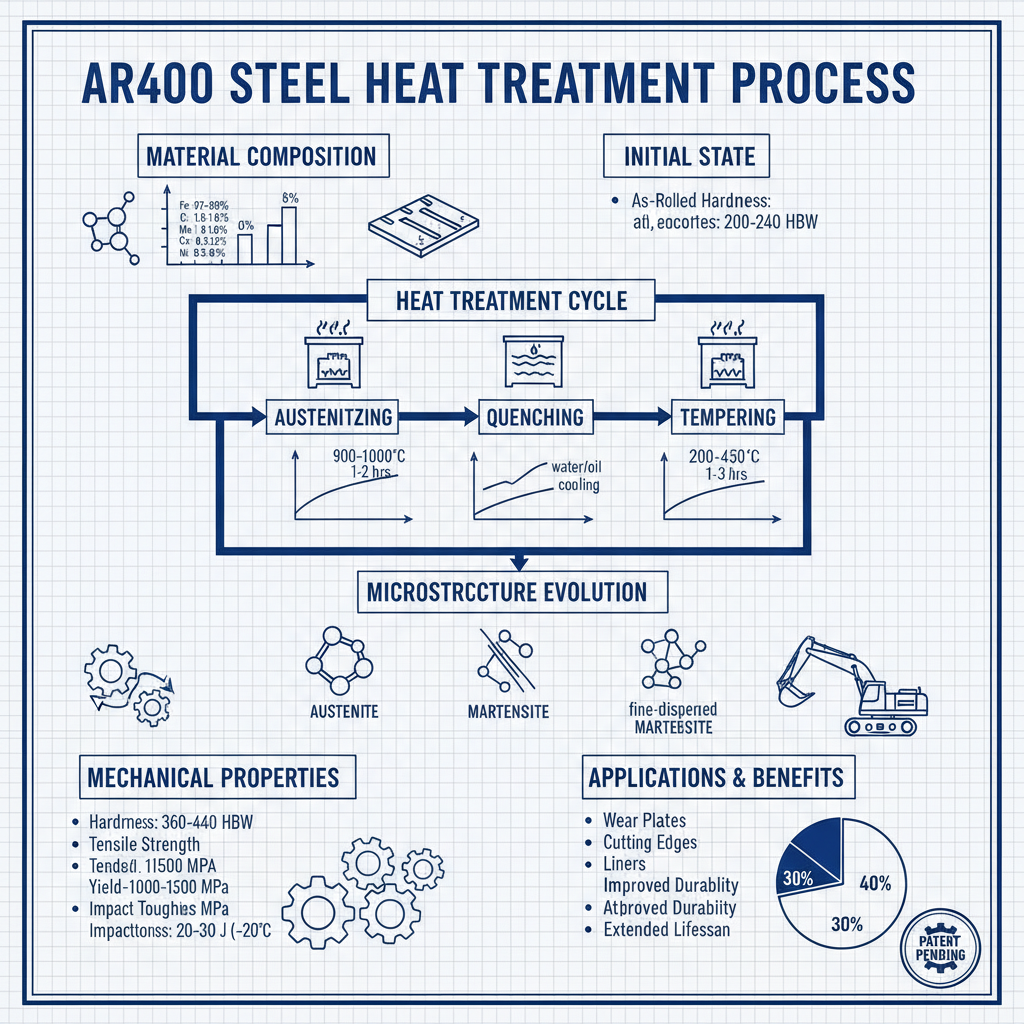
Heat treatment for AR400 steel primarily focuses on achieving the optimal balance between hardness and toughness. Common methods include quenching and tempering. Quenching rapidly cools the steel, transforming its microstructure into martensite, a very hard but brittle phase. Tempering then reduces the brittleness by reheating the steel to a lower temperature, refining the microstructure and improving its toughness.
The connection to modern industry is clear. AR400 steel, with proper heat treatment, is vital for the longevity of equipment in mining, construction, and agricultural sectors. Without this treatment, the steel would quickly succumb to wear and tear, leading to costly repairs and downtime, and impacting productivity and operational efficiency.
Core Components of Effective Heat Treatment
Effective ar400 steel heat treatment hinges on several core components. First, precise temperature control is crucial during both the quenching and tempering phases. Deviations from the recommended temperature ranges can drastically alter the final mechanical properties. Second, the quenching medium – whether water, oil, or polymer solutions – significantly impacts the cooling rate and resulting microstructure.
Third, the holding time at each temperature stage must be carefully calculated and maintained. Insufficient holding times may result in incomplete phase transformations, while excessive holding times can lead to grain growth and reduced toughness. Finally, the cooling rate after tempering is also important, influencing the final tempered martensite microstructure and overall material performance.
These components directly relate to practical applications. For example, in manufacturing heavy-duty truck components, precise temperature control during quenching ensures the necessary hardness to withstand constant abrasion. In the construction industry, proper tempering maximizes the toughness of AR400 steel used in excavator buckets, preventing premature failure during demanding digging operations.
Global Applications of AR400 Steel Heat Treatment
The applications of heat-treated AR400 steel are widespread and globally significant. In the mining industry, it’s used extensively for lining truck beds, wear plates in crushers and screens, and buckets for excavators. These components experience extreme abrasion from ore and rock, and the heat treatment ensures they can withstand these harsh conditions. This is critical in regions like Australia, Chile, and South Africa, which are major mining hubs.
Construction is another key sector. AR400 steel is utilized in bucket teeth for excavators and loaders, as well as in the reinforcement of concrete structures. In rapidly developing economies like China and India, where large-scale infrastructure projects are common, the durability provided by heat-treated AR400 steel is essential. It reduces maintenance frequency and extends the lifespan of critical equipment.
The agricultural sector also benefits, employing heat-treated AR400 steel in components of tillage tools, combine harvesters, and other equipment exposed to abrasive soil conditions. In regions with intensive farming practices, such as the American Midwest and Eastern Europe, this material significantly enhances the efficiency and longevity of agricultural machinery.
Comparison of ar400 steel heat treatment methods
Advantages and Long-Term Value of Optimized Treatment
The advantages of properly implemented ar400 steel heat treatment are substantial. Cost savings are a primary benefit – reducing the frequency of component replacements translates to lower maintenance expenses and minimized downtime. This is particularly impactful in industries with high operating costs, such as mining and oil & gas.
Sustainability is also enhanced. Extended component lifespan reduces the demand for new materials, conserving resources and lowering the environmental impact associated with manufacturing and disposal. Optimized heat treatment contributes to a circular economy by maximizing the utility of existing materials, promoting responsible industrial practices.
Future Trends and Innovations in AR400 Steel Processing
Looking ahead, several trends are poised to shape the future of AR400 steel heat treatment. Advanced modeling and simulation techniques will allow for even more precise control over the process, tailoring heat treatment parameters to specific component geometries and performance requirements. Digital twins, virtual representations of physical assets, will play a role in predicting material behavior and optimizing heat treatment schedules.
Automation and robotics are also expected to increase, streamlining the heat treatment process and reducing human error. Furthermore, research into alternative quenching media, such as advanced polymer solutions, promises to improve cooling rates and reduce distortion. The integration of these technologies will lead to more efficient, reliable, and cost-effective ar400 steel heat treatment.
Challenges and Solutions in AR400 Heat Treatment
Despite advancements, challenges remain in achieving optimal ar400 steel heat treatment. Maintaining uniformity in heat distribution across large or complex components can be difficult, leading to variations in mechanical properties. Another challenge is minimizing distortion during quenching, which can compromise dimensional accuracy and require additional machining.
Solutions include implementing advanced furnace designs with improved temperature control systems and utilizing sophisticated quenching techniques, such as multi-stage quenching. Employing finite element analysis (FEA) to predict distortion during heat treatment can also help optimize process parameters and minimize dimensional changes.
Furthermore, ongoing research into novel alloying additions and heat treatment cycles is aimed at enhancing the material's response to thermal processing and improving its overall performance characteristics, addressing these common challenges.
Summary of AR400 Steel Heat Treatment Challenges and Solutions
| Challenge |
Impact on Performance |
Proposed Solution |
Implementation Cost (1-10) |
| Non-Uniform Heating |
Variable Hardness, Reduced Lifespan |
Advanced Furnace Design, Temperature Mapping |
6 |
| Distortion During Quenching |
Dimensional Inaccuracies, Machining Requirements |
Multi-Stage Quenching, FEA Optimization |
7 |
| Residual Stress |
Increased Crack Propagation Risk |
Stress Relief Annealing, Controlled Cooling |
5 |
| Inconsistent Quenching Medium |
Variable Martensite Formation |
Automated Quenching System, Polymer Quenchants |
8 |
| Lack of Skilled Operators |
Process Control Errors |
Comprehensive Training Programs, Automation |
4 |
| Inadequate Quality Control |
Substandard Mechanical Properties |
Non-Destructive Testing (NDT), Hardness Testing |
3 |
FAQS
Typically, the ideal hardness range for AR400 steel following heat treatment falls between 380-450 Brinell Hardness Number (BHN). However, the specific target hardness depends on the application. Higher hardness usually equates to increased wear resistance, but can reduce toughness. Proper tempering is key to balancing these characteristics, ensuring the steel achieves the required performance while maintaining adequate impact resistance. The selected quenching medium and cooling rate also play significant roles in achieving the desired hardness profile.
The quenching medium dramatically influences the cooling rate and, consequently, the final microstructure of AR400 steel. Water provides the fastest cooling, resulting in a higher martensite content and increased hardness. Oil offers a slower cooling rate, reducing the risk of cracking but also yielding a slightly lower hardness. Polymer solutions provide a controllable cooling rate, offering a balance between the two. Selecting the appropriate medium depends on the steel’s section thickness, component geometry, and desired mechanical properties.
Tempering is a crucial step following quenching in AR400 steel heat treatment. Quenching creates martensite, which is extremely hard but also very brittle. Tempering involves reheating the steel to a lower temperature, reducing the internal stresses and transforming some of the martensite into a more ductile microstructure. This significantly improves the steel’s toughness and impact resistance without drastically sacrificing hardness. Proper tempering is essential for preventing cracking and ensuring the steel can withstand real-world operating conditions.
Yes, AR400 steel can be welded, but requires careful consideration. Preheating the steel before welding is typically recommended to reduce the risk of cracking in the heat-affected zone. Post-weld heat treatment (PWHT) may also be necessary to restore the original mechanical properties of the steel in the weld area. The specific welding procedure and PWHT parameters depend on the steel’s thickness, welding process, and application requirements. It's important to use appropriate filler metals designed for high-strength, low-alloy steels.
Common defects include cracking, distortion, and non-uniform hardness. Cracking often arises from rapid cooling rates or improper tempering. Distortion can occur due to uneven heating or quenching. Non-uniform hardness is frequently caused by inconsistent temperature distribution within the furnace. Careful process control, proper furnace calibration, and the use of appropriate quenching media are essential for minimizing these defects. Regular quality control inspections are also crucial for detecting and addressing any issues.
Temperature control is absolutely critical throughout the entire heat treatment process for AR400 steel. Precise temperature management during austenitizing, quenching, and tempering directly affects the final microstructure and mechanical properties. Deviations from specified temperature ranges can lead to incomplete phase transformations, undesired hardness levels, and increased susceptibility to cracking. Sophisticated furnace control systems and regular temperature calibration are essential for ensuring consistent and reliable results.
Conclusion
In conclusion, ar400 steel heat treatment is a fundamental process in maximizing the material’s exceptional abrasion resistance and strength. Understanding the intricacies of quenching, tempering, and the influence of various parameters like temperature and quenching medium is vital for industries relying on durable and long-lasting components. Optimized heat treatment not only enhances performance but also contributes to cost savings, sustainability, and increased safety.
Looking forward, continued innovation in heat treatment technologies – from advanced modeling and automation to the exploration of new quenching media – will further refine the process and unlock even greater potential in AR400 steel applications. To learn more about achieving optimal ar400 steel heat treatment for your specific needs, visit our website: www.dzmccasting.com.